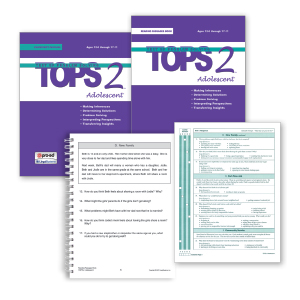
Linda Bowers / Rosemary Huisingh / Carolyn LoGiudice
Ages: 12-0 through 17-11
Testing Time: 40 minutes
Test Purpose
While other tests may assess thinking skills by tapping mathematical, spatial, or nonverbal potential, the TOPS 2 Adolescent assesses critical thinking abilities based on the student's language strategies using logic and experience.
Test Description
The TOPS 2 Adolescent uses a natural context of problem-solving situations related to adolescent experiences and assesses five different decision-making skill areas critical to academic, problem solving, and social success.
The test is comprised of five subtests (18 written passages) that assess a student's performance of these skills. The subtests require the student to pay careful attention to, process, and think about what they hear and read; think about problems with a purpose in mind; resist the urge to be impulsive; and express answers verbally.
Subtests
Subtest A: Making Inferences
The student is asked to give a logical explanation about a situation, combining what he knows or can see with previous experience/background information. Students who do well on this subtest make plausible inferences, predictions, or interpretations.
Subtest B: Determining Solutions
The student is asked to provide a logical solution for some aspect of a situation presented in a passage.
Subtest C: Problem Solving
This subtest requires a student to recognize the problem, think of alternative solutions, evaluate the options, and state an appropriate solution for a given situation. It also includes stating how to avoid specific problems.
Subtest D: Interpreting Perspectives
A student who does well on this subtest will evaluate other points of view in order to make a conclusion.
Subtest E: Transferring Insights
The student is asked to compare analogous situations by using information stated in the passage.
Examiner Qualifications
The test should only be administered by a trained professional familiar with language
disorders (e.g., speech-language pathologist, psychologist).
(TOPS-2) Test of Problem Solving - Adolescent
Code Description Price
TOPS-2-1A Adolescent Virtual Kit (Examiner's Manual and Reading Passages Bundle) $217.00
TOPS-2-2A Test Forms (20) 55.00
Find your component(s) below and click "Add to Cart" to order.
Second Edition