Christopher J. Lonigan / Richard K. Wagner / Joseph K. Torgesen / Carol A. Rashotte
Ages: 6.0 through 89.11 years
Administration: Individual; 15 - 20 minutes
Children entering kindergarten or first grade are expected to have sufficient knowledge of vocabulary, phonological awareness, and print knowledge. TOPEL is a theoretically sound instrument designed to identify preschoolers who are at risk for literacy problems; therefore, allowing early intervention. It is easy to administer; early childhood educators, special educators,
psychologists, diagnosticians, and other professionals who are interested in examine skills related to early literacy can administer the test.
The TOPEL has three subtests. All the results of which are then combined to determine the “Composite Score” that ultimately best represents a child’s emergent literacy skills. It provides valid and reliable raw scores, standard scores, and percentiles. The normative sample consists of 842 preschool-aged children (3 to 5 years), residing in 12 states.
Principal Uses of the TOPEL: Identification: Results are useful for documenting a child’s print, oral vocabulary, and phonological awareness ability. Documentation of Progress: Federal statutes, state laws, and/or school district policies at times require documentation of progress.
Research: Educators can use this instrument to determine intervention-related change or toselect students for research participation.
Subtests:
• Print Knowledge: 36 items; measures alphabet knowledge and early knowledge about written language conventions and form; the child is asked to identify letters and written words, point to specific letters, names specific letters, identify letters associated with specific sounds, and say the sounds associated with specific letters
• Definitional Vocabulary: 35 items; measures single-word oral vocabulary and definitional vocabulary (assesses both surface and deep vocabulary knowledge); the child is shown a picture and asked to tell what the picture is, and to describe one of its important features
• Phonological Awareness: 27 items; measures word elision and blending abilities; the child is asked to say a word, then say what is left after dropping out specific sounds (elision) for the first 12 items; the child is asked to listen to separate sounds and combine them to form a word (blending) for the remaining 15 items.
(TOPEL) Test of Preschool Early Literacy
Code Description Price
TOPEL-1 TOPEL Complete Kit $315.00
TOPEL-2 Manual 124.00
TOPEL-3 Picture Book 131.00
TOPEL-4 Record Booklets (25) 81.00
Find your component(s) below and click "Add to Cart" to order.
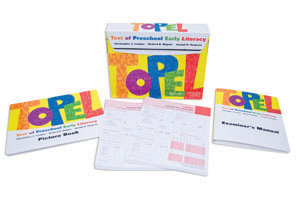
The TOPEL Complete Kit includes:
• Examiner’s Manual
• Picture Book
• Record Booklets (10)