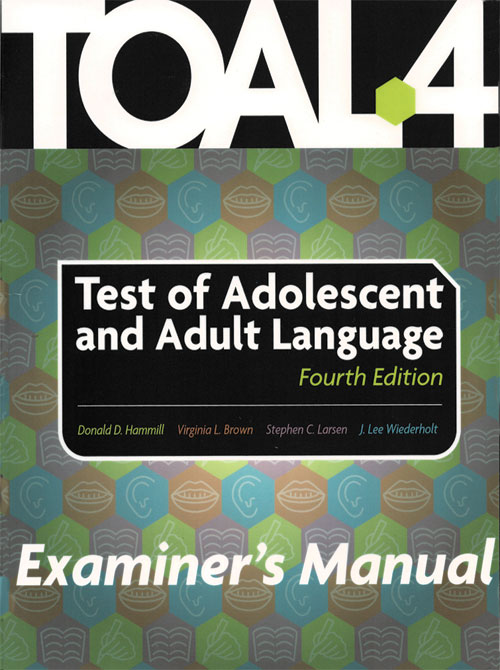
Donald D. Hammill, EdD / Virginia L. Brown / Stephen C. Larsen / J. Lee Wiederholt, EdD
Ages: 12 through 24.11 years
Administration: Individual/Group; 60 min
The Test of Adolescent and Adult Language — Fourth Edition (TOAL-4) is efficient, reliable, and valid. It was designed to measure spoken and written language abilities of adolescents and young adults, with varying degrees of knowledge of the English language.
Subtests:
• Word Opposites: examinee is asked for a spoken word of exact meaning of the word examiner says; the opposite of “Day” is “Night”.
• Word Derivations: examinee is asked for a missing word at the end of the second sentence the examiner says, deriving from a key word; “Laugh. The play was very funny. The people broke out laughing.”
• Spoken Analogies: examinee is asked to finish an examiner’s partial analogous sentence with a word to complete the analogy; “Birds are to sing, as dogs are to bark.”
• Word Similarities: examinee is asked to write a synonym (correct spelling is irrelevant) for a printed stimulus word; “Pig” is written after seeing the word “Hog.”
• Sentence Combining: examinee is asked to write one grammatically correct sentence from the given two or more sentences; “We ate lunch,” and “It was an hour ago” can be combined into, “We ate lunch an hour ago.”
• Orthographic Usage: examinee is asked to write down all the correct words and punctuation marks to all the sentences given; “I want to go home” can be corrected to “I want to go home.”
Composites:
• Spoken Language: formed by combining the scaled scores of the subtests Word Opposites, Word Derivations, and Spoken Analogies.
• Written Language: formed by combining the scaled scores of the subtests Word Similarities, Sentence Combining, and Orthographic Usage.
• General Language: formed by combining the scaled scores of all six subtests.
Technical Information:
All new normative data were collected in the fall of 2004 through the fall of 2005. It was
normed on 1,671 individuals in 35 states, all between the ages of 12-0 years and 24-11. It is nonbiased in regard to gender, race, and ethnicity. Geographic region, gender, ethnicity, Hispanic status, family income level, and parental education were stratified by age.
Fourth Edition
(TOAL-4) Test of Adolescent and Adult Language
Code Description Price
TOAL-4-1 Kit $297.00
TOAL-4-2 Manual $116.00
TOAL-4-3 Examiner Record Booklets (25) $87.00
TOAL-4-4 Written Language Forms $116.00
Find your component(s) below and click "Add to Cart" to order.
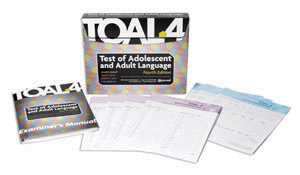
The TOAL-4 Complete Kit includes:
• Examiner’s Manual
• Examiner Record Booklets (25)
• Written Language Forms (25)