
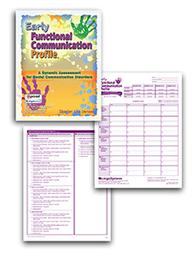

Ages: 2 through 10
Testing Time: 30 to 45 minutes
The targeted skills are hallmarks of atypical development in the preverbal child. The profile measures subtle, functional changes in nonverbal communication skills in children with severe disabilities along with larger gains in children with moderate disabilities. Use it to gather information that will help determine a starting point in therapy and show progress over time.
The Early Functional Communication Profile is appropriate to use with children who have:
-suspected or diagnosed Autism Spectrum Disorder
-severe to profound cognitive impairments
-coexisting disorders
-augmentative and alternative communication
The Early Functional Communication Profile is a criterion-referenced tool. As such, it does not supply age or number scores. The test's precise descriptive measures tell you what the child CAN do and how she responds to different types of prompts.
The assessment is dynamic- a hierarchy of prompts provides information about what skills the child performs with some degree of adult assistance. Skills and the level of progress are delineated by:
-developmental level- skills are arranged from easiest to hardest
-level of environmental prompt- can be where the tester or test items are positioned (e.g., in front, to the side, or in back of the child); a gestural prompt (e.g., handing an object to the child, pointing); or verbal cues (e.g., saying "your turn," asking a question)
-level of adult-action prompt- subtle physical and visual prompts such as hand-over-hand, patting the chest or arm, waiting with hand reaching out, waiting expectantly, etc.
Subtests:
Joint Attention- Requesting Objects
Social Interaction- Turn-taking
Communicative Intent- Requesting Continuation of Actions
Communicative Intent- Requesting Assistance
Social Interaction- Response to Greetings
Joint Attention- Receptive Language
Communicative Intent- Protesting
Code Description Price
EFCP-1 Early Functional Communication Profile $90.00
Find your component(s) below and click "Add to Cart" to order.
(EFCP) Early Functional Communication Profile
Sharlet Lee Jensen
COMPLETE KIT INCLUDES:
Examiner's Manual and 15 Profile Forms.