The CTOPP-2 has four principal uses: (1) to identify individuals who are significantly below their peers in important phonological abilities, (2) to determine strengths and weaknesses among developed phonological processes, (3) to document individuals' progress in phonological processing as a consequence of special intervention programs, and (4) to serve as a measurement device in research studies investigating phonological processing.
Subtests:
• Elision: the ability to remove phonological segments from spoken words to form other words.
• Blending Words: measures the ability to synthesize sounds to form words
• Sound Matching: measures the ability to select words with the same initial and final sounds.
• Phoneme Isolation: measures the ability to isolate individual sounds within words.
• Blending Nonwords: measures the ability to synthesize sounds to form nonwords.
• Segmenting Nonwords: measures the ability to segment nonwords into phonemes.
• Memory for Digits: measures the ability to repeat numbers accurately
• Nonword Repetition: measures the ability to repeat nonwords accurately
• Rapid Digit Naming: measures the ability to rapidly name numbers
• Rapid Letter Naming: measures the ability to rapidly name letters.
• Rapid Color Naming: measures the ability to rapidly name colors.
• Rapid Object Naming: measures the ability to rapidly name objects.
Composites:
• Phonological Awareness Composite Score (PACS): represents the examinee’s awareness of and access to the phonological structure of oral language.
• Phonological Memory Composite Score (PMCS): represents the examinee's ability to code information phonologically for temporary storage in working or short-term memory.
• Rapid Symbolic Naming Composite Score (RSNCS): measures the examinee’s ability to include
efficient retrieval of phonological information from long-term or permanent memory and execute a sequence of operations quickly and repeatedly.
• Rapid Non-Symbolic Naming Composite Score (RNNCS): measures the examinee’s ability to include efficient retrieval of phonological information from long-term or permanent memory
and executing a sequence of operations quickly and repeatedly using objects and colors.
• Alternate Phonological Awareness Composite Score (APACS): measures the examinee’s phonological awareness exclusively with nonwords.
Scoring:
The CTOPP-2 yields six types of normative scores: age equivalents, grade equivalents, percentile ranks, subtest scaled scores, composite indexes, and developmental scores. Percentile ranks are easily understood by parents and others with whom the examiner might want to share the results. Ages: 4.0 through 24.11
(CTOPP-2) Comprehensive Test of Phonological Processing - Second Edition
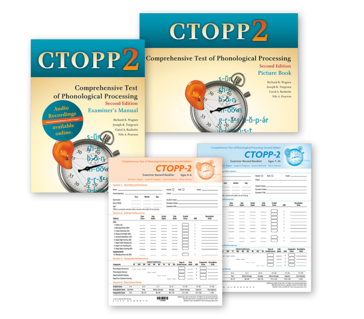
The CTOPP-2 Complete Kit includes:
• Examiner’s Manual
• Examiner Record Booklets: Ages 4-6 (25)
• Examiner Record Booklets: Ages 7-24 (25)
• Picture Book
• Core Subtest CD-ROM
• Supplemental Subtest CD-ROM
User Qualifications Required
Richard Wagner / Joseph Targesen / Carol Rashotte / Nils A. Pearson
Testing Time: 40 minutes
Administration: Individual