
(CAYC) Cognitive Assessment of Young Children
M. Beth Langley / Rebecca Fewell / Taddy Maddox
The Cognitive Assessment of Young Children (CAYC) is a newly developed easy-to-administer screening and assessment tool used to identify children with developmental delays. It is based on the same reliable, successful, theoretical model upon which the DASI (Developmental Activities Screening Inventory) and DASI-II were both designed.
The CAYC serves four main purposes:
• Early Identification of Developmental Delay in order to facilitate early intervention.
• Determination of Strengths and Weaknesses contributes valuable information to the total
diagnostic effort.
• Documentation of Progress provides clinicians, early childhood educators, teachers, diagnosticians, and psychologists a base to monitor change and evaluation. Conclusions can then be made on whether to continue, modify, or terminate the intervention program.
• Research Data can be collected from the well-constructed, reliable and valid results.
Test Structure:
The CAYC consists of 107 structured, play-based items in six age-related levels. Items within each level are sequenced according to increasing difficulty, and later tasks build on earlier skills.
This allows examiners to establish basals and ceilings, thereby limiting evaluation time and making it less likely that the child will become frustrated. The materials and activities presented to the child are very similar to those encountered in early intervention programs. Most youngsters find them engaging, motivating, and enjoyable. (Note: Children must have sufficient hearing, vision, and movement skills to understand and respond to test items.
Each level consists of developmental and mega-cognitive tasks, including, but not limited
to the following: (a) fine motor coordination and planning, (b) interactive communication and play, (c) memory, (d) reasoning, (e) perceptual development, (f) processing, (g) classification and organizational skills, (h) concept development, (i) practical knowledge, and (j) components of early learning skills.
Technical Information:
The CAYC provides three kinds of normative scores: percentile ranks, age equivalents, and index scores. Standardization is based on a sample of 743 children, nationally representative in regard to gender, geographic region, ethnicity, family income, and parental education.
Ages: 2 months to 5.11 years
Administration: 15 - 30 minutes
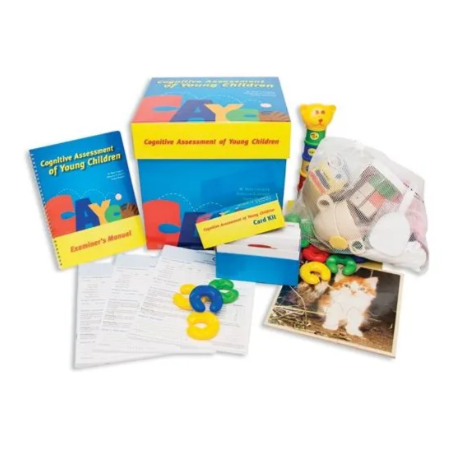
The CAYC Complete Kit includes:
• Examiner’s Manual
• Card Kit
• Examiner’s Record Booklet (25)
• Object Kit
