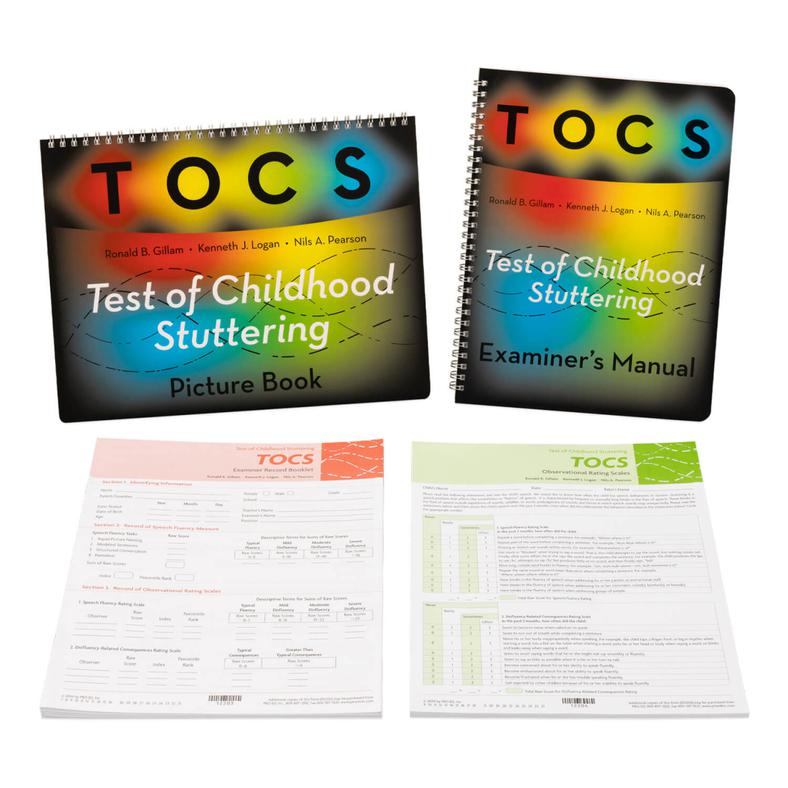
Ronald B. Gillen / Kenneth J. Logan / Nils A. Pearson
Ages: 6 - 17
Testing Time: 30-45 minutes
Administration: Individual or Group
The TOCS provides clinicians and researchers with a sound method for assessing speech fluency skills and stuttering-related behaviors in children. Its main purposes are to (1) identify children who stutter, (2) determine the severity of a child’s stuttering, and (3) document changes
in a child’s fluency functioning over time. It can also be used as a tool in research on childhood stuttering. The TOCS is comprised of three major components: The Standardized Speech Fluency Measure; The Observational Rating Scales; and The Supplemental Clinical Assessment.
The Standardized Speech Fluency Measure:
• Rapid Picture Naming: Children are to name a series of 40 pictures as quickly as possible. This determines how fluently children produce single words in a time-stressed context.
• Modeled Sentences: Children are shown two pictures, side-by-side, differing in one important detail. The examiner says a sentence about one of the pictures. Children are to produce sentences that contain the same syntactic structure of the sentence the examiner has modeled. This evaluates children’s ability to speak fluently in a context in which sentences that vary in syntactic complexity must be formulated and then spoken.
• Structured Conversation: Children are asked to answer open-ended questions about a eight picture sequence. This evaluates children’s ability to speak fluently in a dialogue context.
• Narration: Children are to generate a story based on the picture cards used in “Structured Conversation.” This assesses children’s ability to speak fluently in a monologue context.
The Observational Rating Scales:
The Speech Fluency Rating Scale and the Disfluency-Related Consequences Rating Scale enable the examiner to gather information about stuttering and related behaviors from parents, teachers, and other individuals who have known the child for an extended period of time.
The Supplemental Clinical Assessment:
Eight supplementary fluency-related assessments enable examiners to probe disfluency-related data in greater detail: Clinical Interviews; comprehensive analysis of disfluency frequency and types; speech rate analysis; disfluency duration analysis; repetition length analysis; associated behavior analysis; stuttering frequency analysis; and speech naturalness analysis.
(TOCS) Test of Childhood Stuttering
Code Description Price
TOCS-1 TOCS Complete Kit $244.00
TOCS-2 Manual 90.00
TOCS-3 Examiner Record Booklets (25) 60.00
TOCS-4 Observational Scales (25) 41.00
TOCS-5 Picture Book 62.00
Find your component(s) below and click "Add to Cart" to order.