Virginia Brown / Mary Cronin / Diane P. Bryant
Ages: 8 through 18.11 years
Administration: Individual; 60 - 90 minutes
The Test of Mathematical Abilities–Third Edition (TOMA-3) is an easily administered, norm referenced, assessment tool used to identify, describe, and quantify mathematical deficits in school age children. Specifically, it can be used to identify students who are significantly behind their peers in mathematical knowledge and to determine the magnitude (below average, poor, or very poor) of any mathematical problems.
TOMA-3 Subtests:
• Mathematical Symbols and Concepts: Students answer a series of multiple-choice questions that relate to mathematical signs, symbols, words, or phrases.
• Computation: Students solve a series of problems that increase in difficulty.
• Mathematics in Everyday Life: Students answer a series of multiple-choice questions that relate to the use of mathematics in everyday life.
• Word Problems: Students solve a series of increasingly difficult word problems.
• Attitude Toward Math (Supplemental): Students express their attitudes about mathematics instruction and their self-perceptions regarding their own abilities and achievement. For each statement the student marks one of four boxes.
TOMA-3 Composite:
• Mathematical Ability Index: Represents a broad range of the features and systems associated with mathematical ability.
Statistical and Technical Characteristics of the TOMA-3:
• Norms: The TOMA-3 is normed on 1,456 students aged 8-0 through 18-11 years living in 21 states.
• Scores: Mathematical Ability Index, Age and Grade Equivalents, Subtest Scaled Scores, Percentile Ranks, and SEM’s.
• Reliability: Content, time, and scorer coefficients are consistently high.
• Validity: Content-description, criterion-prediction, and construct-identification provide strong support that the TOMA-3 is a valid measure.
(TOMA) Test of Mathematical Abilities
Code Description Price
TOMA-3-1 Test of Mathematical Abilities-Third Edition Complete Kit $232.00
TOMA-3-2 Examiner’s Manual $87.00
TOMA-3-3 Examiner Record Forms (25) $63.00
TOMA-3-4 Student Response Booklets (25) $85.00
Find your component(s) below and click "Add to Cart" to order.
Third Edition
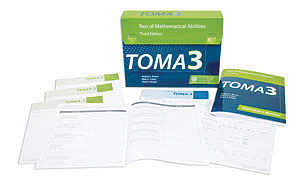
The TOMA-3 Complete Kit includes:
• Examiner’s Manual
• Examiner Record Forms (25)
• Student Response Booklets (25)